Juanita Kelly
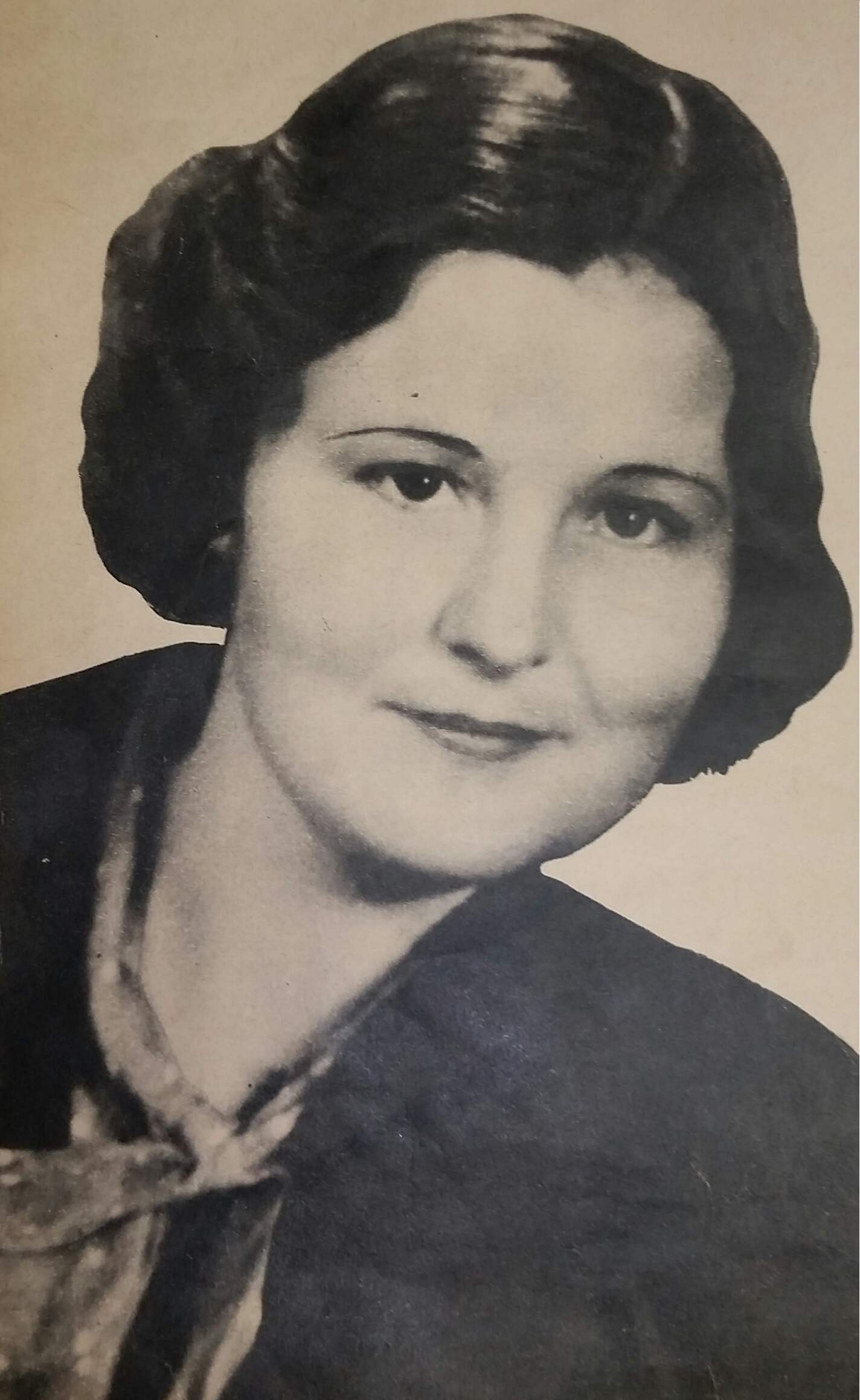
By all accounts, twenty-one-year-old Juanita Kelly was a lively, beautiful, fun-loving young woman with big brown eyes, dark curly hair, dimples, and a distinctly feminine figure.
She had recently moved from the family farm near Morton to Clovis, New Mexico, where she worked as a waitress, fell in love, and became engaged.
Excited to share the news with her parents, Sam and Dollie Kelly, Juanita returned to the family farm eight miles northeast of Morton. While at home, she helped her mother with the housework and worked beside her father in the fields. Always willing to lend a hand, Juanita settled easily back into family life.
On Saturday, October 17, 1936, the Kelly family spent the day picking cotton. They quit work early, loaded into the car, and drove to Morton to conduct business and enjoy the evening. With their errands finished, the family decided to attend the only entertainment in town that night, a cowboy movie at the Wallace Theater. Juanita, however, chose instead to go to a widely advertised dance being held at the dance hall five miles west of Morton.
After agreeing to meet her parents and siblings at eleven o’clock, Juanita drove the family car to the dance. She returned alone about thirty minutes late. Scolded by her mother, she apologized and said she had been having such a good time that she forgot to watch the clock. She then told her parents she had a date with Asa Smith and wanted to return to the dance. Her parents reluctantly consented, agreeing that Asa was an intelligent and well-respected young man who could be trusted to escort their daughter.
“I’m going to meet him at the post office,” were the last words Juanita ever spoke to her parents as they watched her walk away from the Wallace Theater toward the post office.
Missing
By Sunday morning, Juanita had not returned home. Her parents assumed she had stayed overnight with one of her girlfriends. But when she failed to return later that day, real worry set in. Juanita was not the kind of girl to leave without sending word to her family.
The anxiety deepened Monday morning, when Dollie Kelly became distraught over a dream she had the night before. In it, Juanita was lying in a shallow grave, naked, blood-smeared, and mutilated. Trying to calm his wife, Sam Kelly reminded her of an old saying: “Dream of a marriage and it means a death, dream of death and it means a marriage. Juanita’s going to marry that fellow over at Clovis, that’s what your dream means!” But neither Dollie’s fear nor Sam’s own growing unease was relieved.
By Tuesday morning, October 20, there was still no word from Juanita. Her mother was inconsolable, and her father had grown so worried that he left his work in the middle of harvest and began making inquiries among Juanita’s friends and relatives. None of them knew where she was.
Sam Kelly went to the sheriff’s office in Morton and spoke with Deputy Reed House. House suspected the girl had returned to Clovis to her fiancé. He telephoned Clovis police and asked them to check with the fiancé to see whether Juanita had gone back there. Sam Kelly also asked the deputy to check with Asa Smith.
Later that evening, a Clovis officer contacted Sheriff John Crockett and reported that Juanita’s fiancé had not seen her since she left several weeks earlier and was genuinely worried upon hearing that she had been reported missing. He also had an alibi for the night of the dance, having been with another girl when Juanita disappeared. Officers in Hobbs were contacted next, but Juanita was not there either.
Believing she might possibly have gone to Lubbock, Sheriff Crockett contacted the Lubbock County Sheriff’s Office on Wednesday evening. Lubbock authorities, in turn, alerted local newspapers and radio stations, broadcasting Juanita’s description and the circumstances of her disappearance.
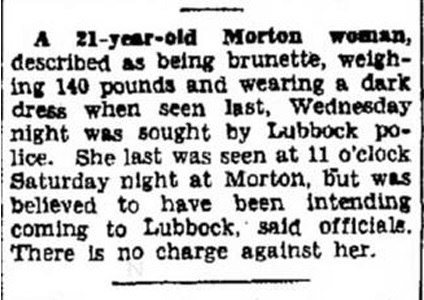
The Investigation
Sheriff Crockett decided to speak with Juanita’s fiancé in person while Deputy House questioned others who had attended the dance. Those interviewed said Juanita appeared to be having the time of her life. More than a dozen young men had danced with her that evening, but no one could say for certain who she left with. No one even remembered seeing her at the dance after about 11:30 p.m.
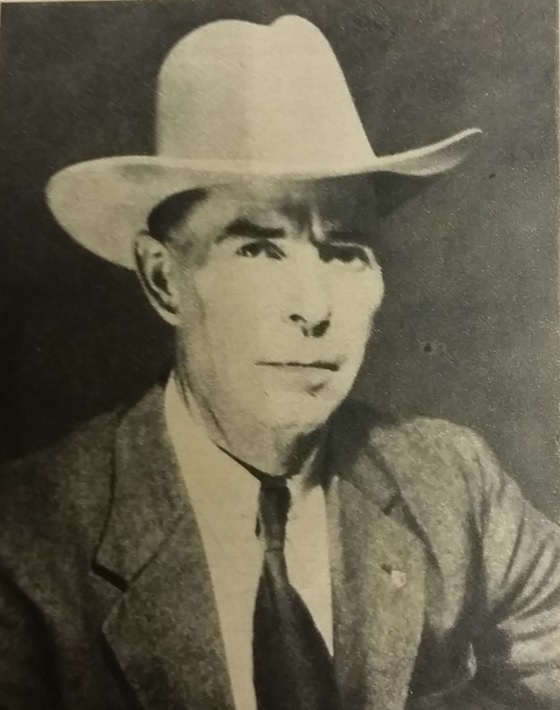
Deputy House saved Asa Smith for last.
Smith was irritated by the questioning. “I didn’t take Juanita home,” he said. “Furthermore, I don’t like the talk that is going around town. It seems like I was supposed to take Juanita home. Well, I didn’t!”
Smith explained that he had gone to the dance with his girl and her friend and had spent the evening occupied with the two of them, dancing with his companion and finding partners for the other girl. He said he took both of them home, stopping first at a local café for something to eat. He also stated that he had seen Juanita dancing several times with Odis Cooper, who was at the dance without his wife.
Interviews with the two women confirmed Smith’s account. They said he left the dance hall with them around 11:30 and dropped them off at home around midnight.
Deputy House then went to the Cooper farm, where he found Odus Cooper supervising a gang of cotton pickers. Cooper appeared nervous and shifted from foot to foot as he spoke.
“I don’t like to be mixed up in this affair any more than I have to,” Cooper said. “I left my wife at her mother’s that night, and she didn’t know I was going to the dance.”
He admitted dancing with Juanita several times. When asked whether he had seen her leave the dance, he replied, “I did see her leave in a car with Asa Smith somewhere around 11:30. I had gone to my car to take a drink and had to back up so that Smith could get his machine out of the jumble of cars.”
Asked if he was sure it had been Asa Smith, Cooper replied, “Dead sure.”
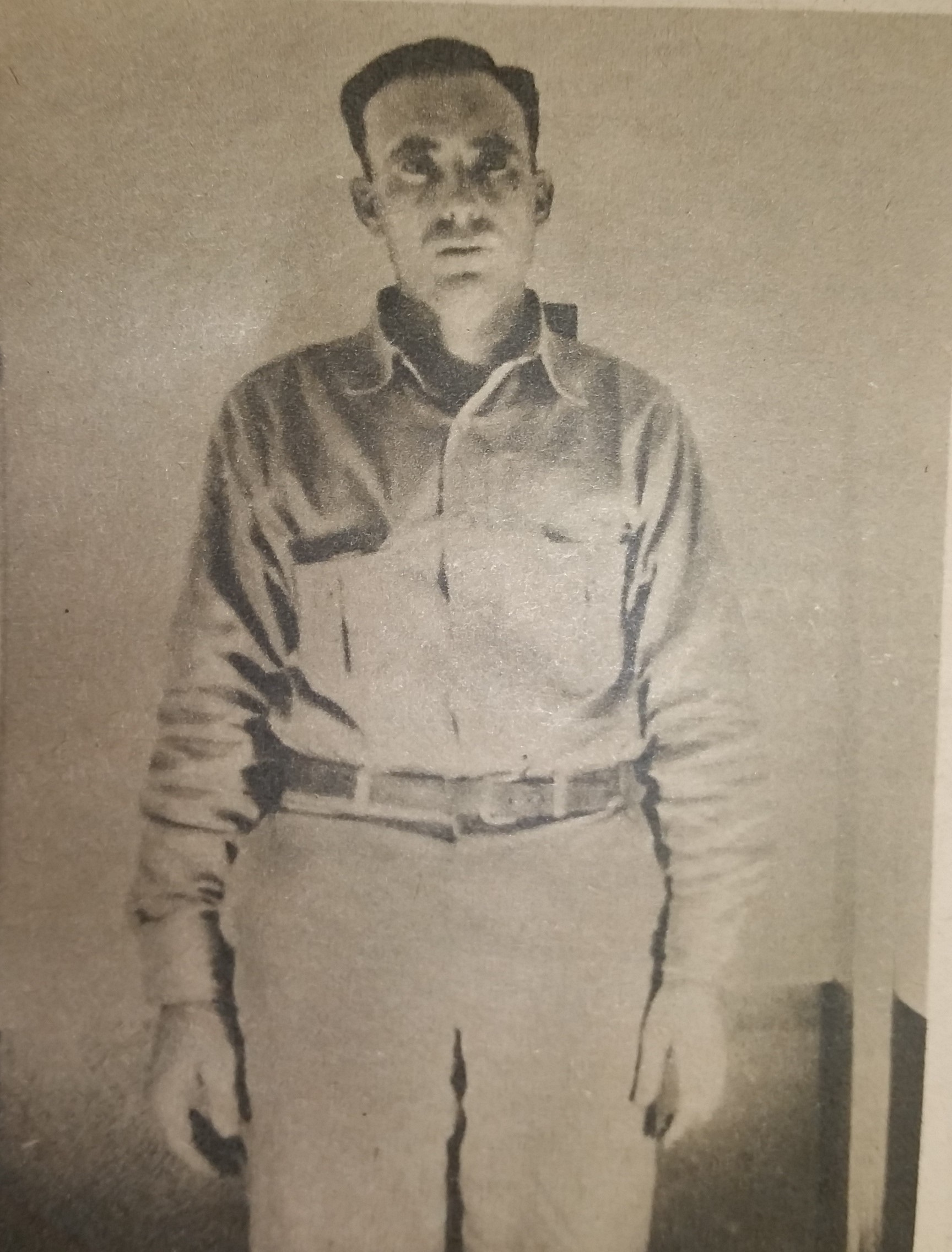
Further questioning of Cooper’s acquaintances revealed that he was said to be “head over heels” in love with Juanita and that the two had reportedly been involved for over a year. It was also learned that Saturday night was not the first time Cooper had taken his wife and daughters to her mother’s house when he claimed to have “special work” to do. Their meetings had reportedly escaped widespread gossip in part because Cooper’s wife, Lois, and Juanita were cousins.
By Saturday, a week after the dance, Sheriff Crockett and Deputy House had given up hope of finding Juanita alive. They spent that day and the next searching county roads and the land surrounding the dance hall, looking for any trace of her body or a grave. They found nothing. Her disappearance seemed destined to remain a mystery.
The Body Is Found
Then, on the afternoon of Monday, October 26, 1936, a trembling Odus Cooper, his face twisted with grief and horror, burst into Sheriff Crockett’s office shouting, “I’ve found the body of Juanita Kelly!”
“She’s dead?” Crockett asked.
“Dead and buried on my farm!” Cooper replied miserably.
Deputy House immediately demanded to know when Cooper had found her. Cooper answered, “Last Thursday.”
“I interviewed you last Friday! Why didn’t you tell me then?” House snapped.
“You don’t know the hell I’ve been through since I found that body! I was scared to death that I would be implicated!” Cooper cried.
Cooper then explained that on Thursday evening, while driving stray cattle from a neighboring field, he had noticed tire tracks in his Sudan field, about half a mile north of his farmhouse. Since no cars should have been there, he followed the strange zig-zag trail until he came to a mound of freshly turned earth. Digging into it with his hands, he touched cold flesh. Panic-stricken, he covered the opening back up.
Within minutes, officials were racing to the scene. District Attorney Dan Blair and his assistant, Burton Burks of Lubbock, hurried to Morton, where Justice J. P. Taylor, Dr. R. E. Rushing, Dr. D. T. Jordan, and Juanita’s father, Sam Kelly, were already waiting.
The group traveled to Cooper’s farm, two miles south of the dance hall, where Cooper’s uncle, Robert Fulton, led them to the grave. Deputy House used a small shovel to cut through the packed soil, remarking that the earth had not been disturbed since the heavy rain of the week before. He also noted that marks in the grave wall suggested it had been dug with a grubbing hoe.
Juanita Kelly’s nude body lay face up, wedged tightly into a grave only fourteen inches wide. A deep slash cut across her cheek. Her throat had been cut ear to ear. Her right eye hung from its socket, the result of a savage blow that had crushed her temple. Shreds of her blouse still clung to her body. Her cloak and shoes, which were placed toe-to-heel as if packed in a shoebox, lay at her feet.
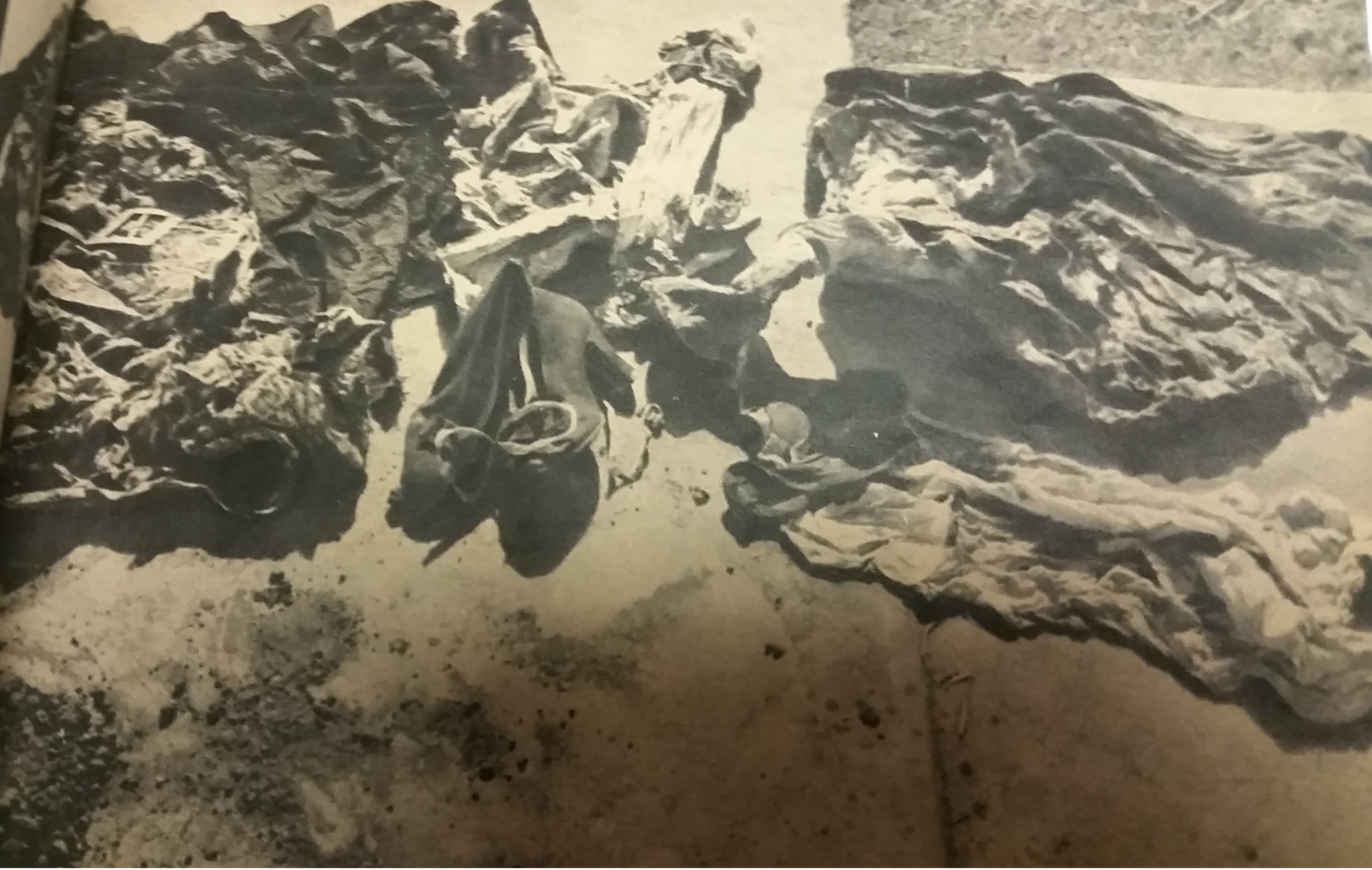
Once the grave had been widened enough to remove her, Juanita’s body was wrapped in a quilt, covered with a sheet, and taken to a vacant building in Morton, where Justice Taylor conducted an inquest.
During the inquest, it was determined that Juanita’s neck had been dislocated at the second vertebra, and the cut to her throat circled nearly her entire neck so that her head was barely attached by strings of tissue. She had nearly been decapitated. Evidence suggested that she had also been sexually assaulted.
Fearing mob violence if Cooper remained in Morton, officers quickly transferred him to the Lubbock County Jail, where Sheriff Tom Abel, Chief Deputy Bedford Carpenter, Patrolman Brooks Penney, District Attorney Blair, and Burton Burks began an intense interrogation late that night. Cooper insisted he was innocent of anything except burying Juanita’s body.
At four o’clock the next morning, Tuesday, October 27, he and a group of officers, prosecutors, and investigators took Cooper back to the grave.
Reporter Huntsucker photographed him there by flashlight.
“Are you going to print this beforehand?” Cooper asked.
“Probably,” the reporter replied.
“I don’t think that fair,” a dejected looking Cooper stated, but offered no further explanation.
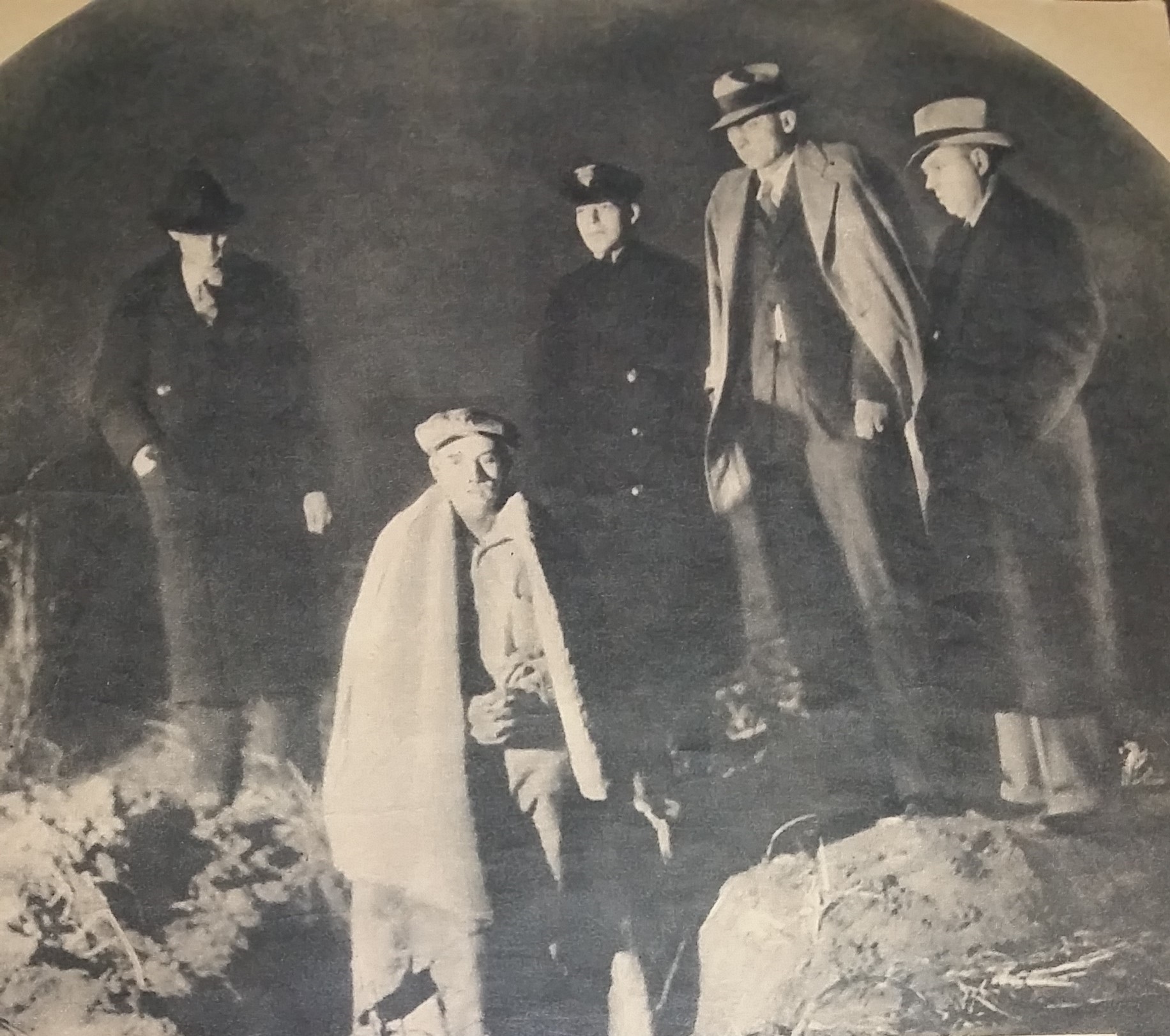
Left to right: Sam Fort, Odus Cooper, Brooks Penney, Daniel Blair & Burton Banks
The men searched the farm, outbuildings, loose dirt, and refuse piles. They examined Cooper’s automobile and noted an odor similar to that found at the grave. Hair and stains were collected for analysis.
Patrolman Penney later accompanied George Smith, Asa Smith’s father, to the Smith farm, where a bloody grubbing hoe head was found lying in the flower garden.
By evening, Sam Fort had recovered usable fingerprints from the hoe head. Every print matched Odus Cooper.
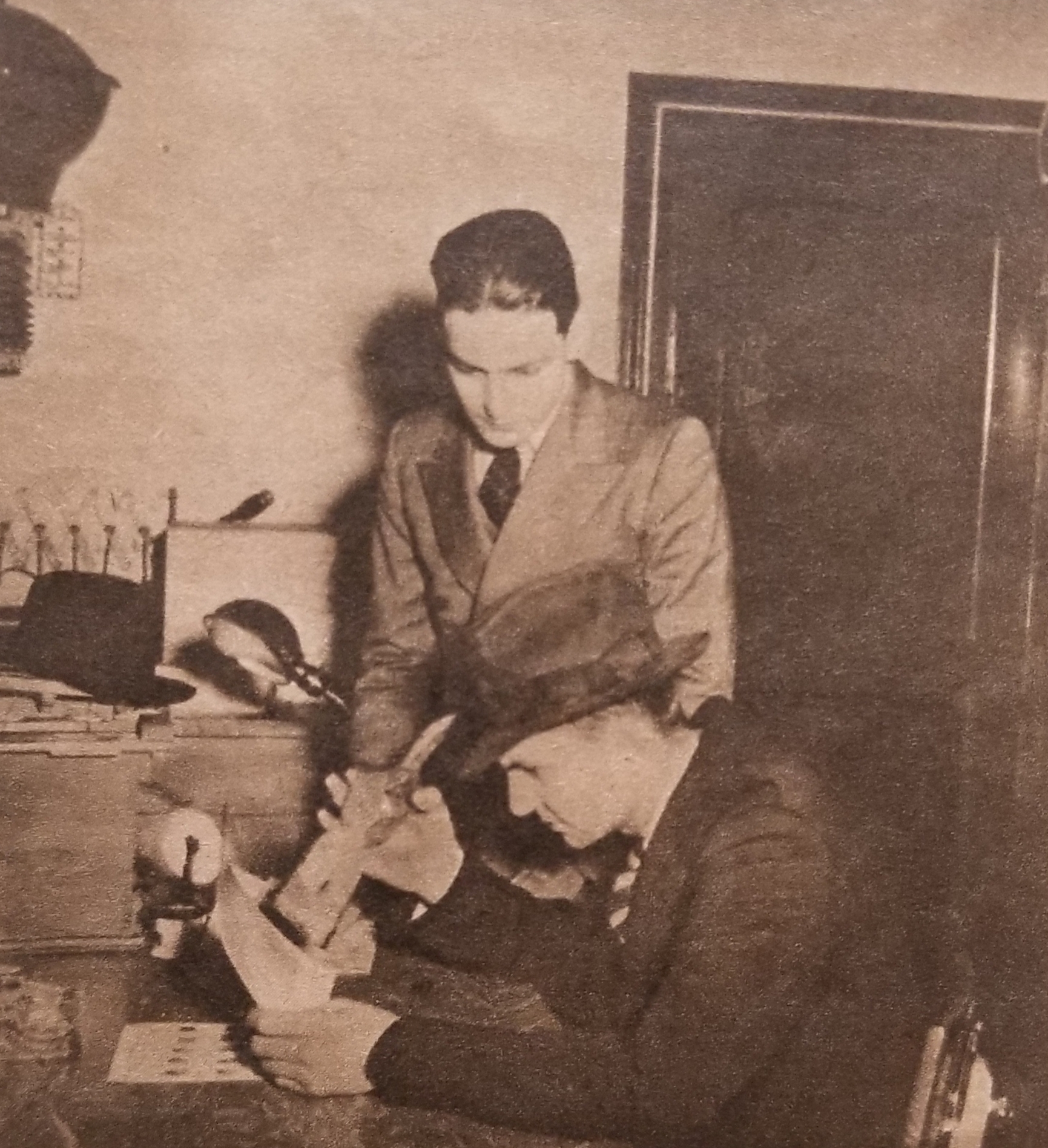
Odus Cooper'sprints while Patrolman Brooks Penney looks on.
Cooper’s Story
Confronted with the fingerprint evidence, Cooper finally admitted that he had not been telling the truth. But what followed was not a confession to murder. Instead, he offered a new story, one officers believed to be only “nearly straight.”
According to Cooper, he picked Juanita up at the post office after she left her parents and drove with her to a dark road near his farm. There, he claimed, while they were drinking and making love in his car, two men appeared out of the darkness. One put a gun in his ribs and ordered him out. That man then pulled Juanita from the car and tried to assault her. When she came to and made a wisecrack, he struck her in the head with a heavy wine bottle.
Cooper claimed the stranger then forced him to carry Juanita’s body into the field, took Cooper’s pocketknife, and cut her throat, stabbed her cheek, and slashed the back of her neck while holding him at gunpoint.
He later led officers to several buried items, including a heavy studded wine bottle, Juanita’s skirt, a white-handled pocketknife, washed trousers, and a bloodstiffened seat cover.
Juanita’s skirt was dug up from a rut in a road two miles from Cooper’s home.
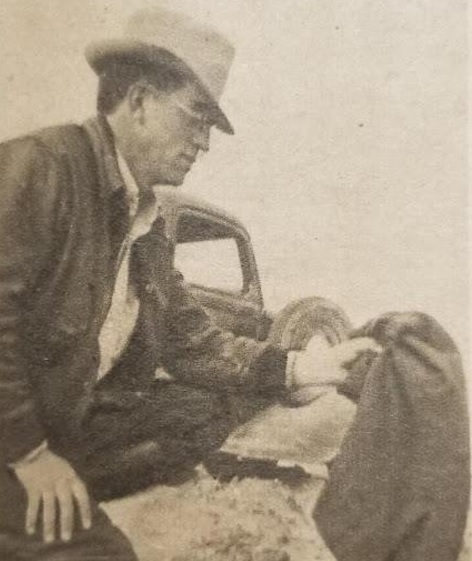
The grubbing hoe handle was recovered from the brush near the Smith farm, where Cooper had planted the bloody grubbing hoe head.
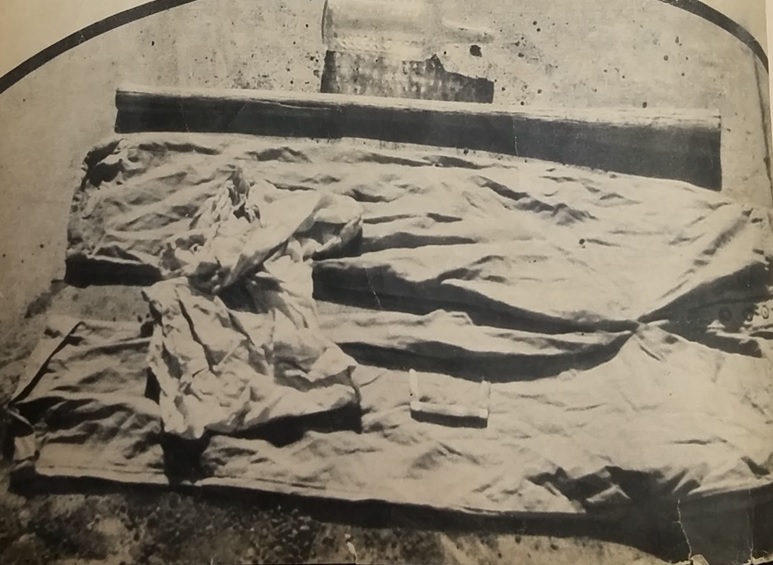
and the pocketknife used to cut her throat.
The officers remained unconvinced. There was no physical evidence that anyone besides Cooper and Juanita had been in the field.
Suicide and Aftermath
The next morning, Wednesday, October 28, Deputy Parum Posey entered to bring Cooper food and found him dead on the floor of his jail ward, lying in a pool of blood. A razor blade lay near his foot. Around midnight, almost the exact hour Juanita was believed to have been murdered, Cooper had used the hidden razor blade to slash the artery in his arm. He bled to death alone.
His death was ruled suicide.
Cooper’s widow later explained how he had obtained the blade. She said he had hidden it inside his shoe before ever reporting the location of Juanita’s body.
Examination of the shoe did not show readily that the stitches had been cut and the two soles fit together tightly.

To many, Cooper’s suicide was confession enough: the act of a man crushed by guilt, fear, or both. He was buried in Morton Memorial Cemetery on Thursday, October 29, 1936, only a short distance from Juanita Kelly.
In a letter to Juanita’s parents, her fiancé in Clovis wrote of his grief and his lasting love for her. “We had planned great things together,” he said.
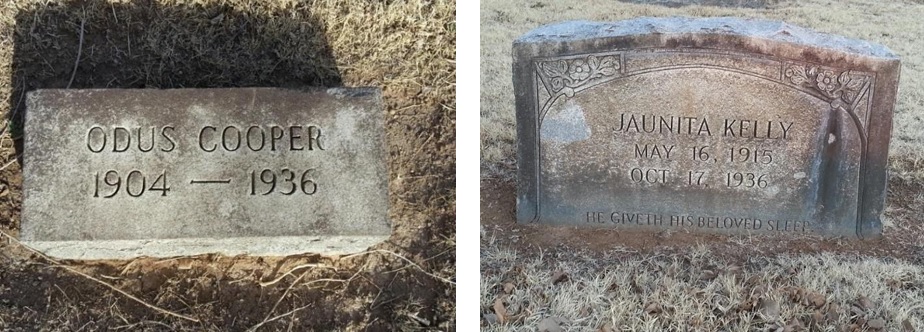
In an article published in the Lubbock Morning Avalanche on Saturday, October 31, 1936, Sheriff Crockett reported that new evidence had been discovered near the grave where Juanita Kelly’s body was found, evidence he believed might lead to the reopening of the investigation. Crockett stated that “three new angles” were being investigated, though he declined to comment on two lines of inquiry already under consideration. He did reveal that an out-of-state investigator, digging in the loose dirt directly west of the grave, had uncovered soil buried in the field that did not come from Cooper’s land. “In that dirt, which had caked, was a man’s heel print and imprint of an automobile,” Crockett said as he showed a photograph of the heel print. Sam Fort added, “The print of the heel is left by only one brand of shoes.”
Crockett also shared that he had traveled to Lubbock on Thursday, October 29, to confer with Fort about the new evidence. “Some of the information I have is not suitable for print,” he said, “but I will tell you this. There have been three discoveries, two of them important. I have told Mr. Fort everything. Neither he nor I believe this case has come to light in its entirety.”
Fort went on to say, “What Mr. Crockett has found makes it look like that girl could have been done away with by more than one. It looks mighty funny to me. Mr. Crockett will not stop with what he has. It looks like he is not working alone either. A lot of Morton citizens have talked to him and they have offered to help him in further investigation. When he is satisfied one person, and only one person, was guilty of that girl’s death, well he’ll mark the case up as closed. That is, provided he is satisfied who that person was or is.”
No additional suspects were ever publicly named, and no further information was publicly released regarding the case.
Sources
- 1937 interview of J. S. Crockett by Jesse Simmons
- 1937 interview of J. S. Crockett and Tom Abel by Margie Harris
- Lubbock Morning Avalanche, October 27, 1936
- Lubbock Morning Avalanche, October 28, 1936
- Dallas Morning News, October 28, 1936
- Lubbock Morning Avalanche, October 29, 1936
- Dallas Morning News, October 29, 1936
- Lubbock Morning Avalanche, October 30, 1936
- Lubbock Morning Avalanche, October 31, 1936
- Photographs courtesy Texas’ Last Frontier Historical Museum
- Headstone photographs courtesy Mary Helen McKnight
A note from Mary McKnight
In researching this tragic event in Cochran County’s history, I came across numerous sources covering Miss Kelly’s murder. Not only did the case make local and state news, it was reported nationwide. I found coverage in newspapers from Maryland, California, Oklahoma, New Mexico, Missouri, Pennsylvania, Colorado, and Ohio, to name only a few, in addition to various Texas newspapers from El Paso to Corpus Christi. It also appeared in two true-crime detective magazines that were sold worldwide. I believe what made this story so compelling was the combination of the horrific manner in which Juanita Kelly was murdered and the mystery surrounding it.
The many articles, stories, and accounts of Miss Kelly’s murder tend to draw the reader in, and the large amount left unresolved in the case naturally leads people to form their own theories about what happened that night. I have discussed the case with several people after they had read through the accounts, articles, and research, and interestingly, not a single one of them came away fully convinced that Cooper murdered her. Some have even expressed the belief that Cooper himself may have been murdered. It is also striking that, during these discussions, the same four individuals are repeatedly suggested as possible suspects, often with well-thought-out arguments as to why they may have been the murderer.
I remember reading Cooper’s final statement in the Lubbock Morning Avalanche about the two men he claimed had actually murdered Juanita Kelly. A few days later, I came across an article in the Evening News-Journal of Clovis, New Mexico, covering the Kelly murder, and on the same page was another story about two men being sought in New Mexico for the murder of a woman whose body had been found mutilated and buried in a manner similar to Miss Kelly’s. Reading the two accounts side by side made me wonder whether there was any truth to Cooper’s final statement regarding the two men. Was this case connected to the out-of-state investigator who reportedly discovered additional evidence after Cooper’s death? It would make sense that the investigator may have been from New Mexico, given that Cochran County borders that state. Or had Cooper himself heard of the New Mexico case and used it to cast doubt on his own guilt?
What truly happened that fateful night was never fully known, and probably never will be.